
Gallery Hours are Thursday, Friday, and Saturday afternoons, 12-5 PM
OR by appointment, contact us at info@jazzgallerycenterforarts.org
Masks and other COVID-19 precautions are encouraged for all visitors.
Exhibition
June 13th, 2026 – July 17th, 2026
Opening Reception
Saturday, June 13th, 2026 from 4 – 6 PM
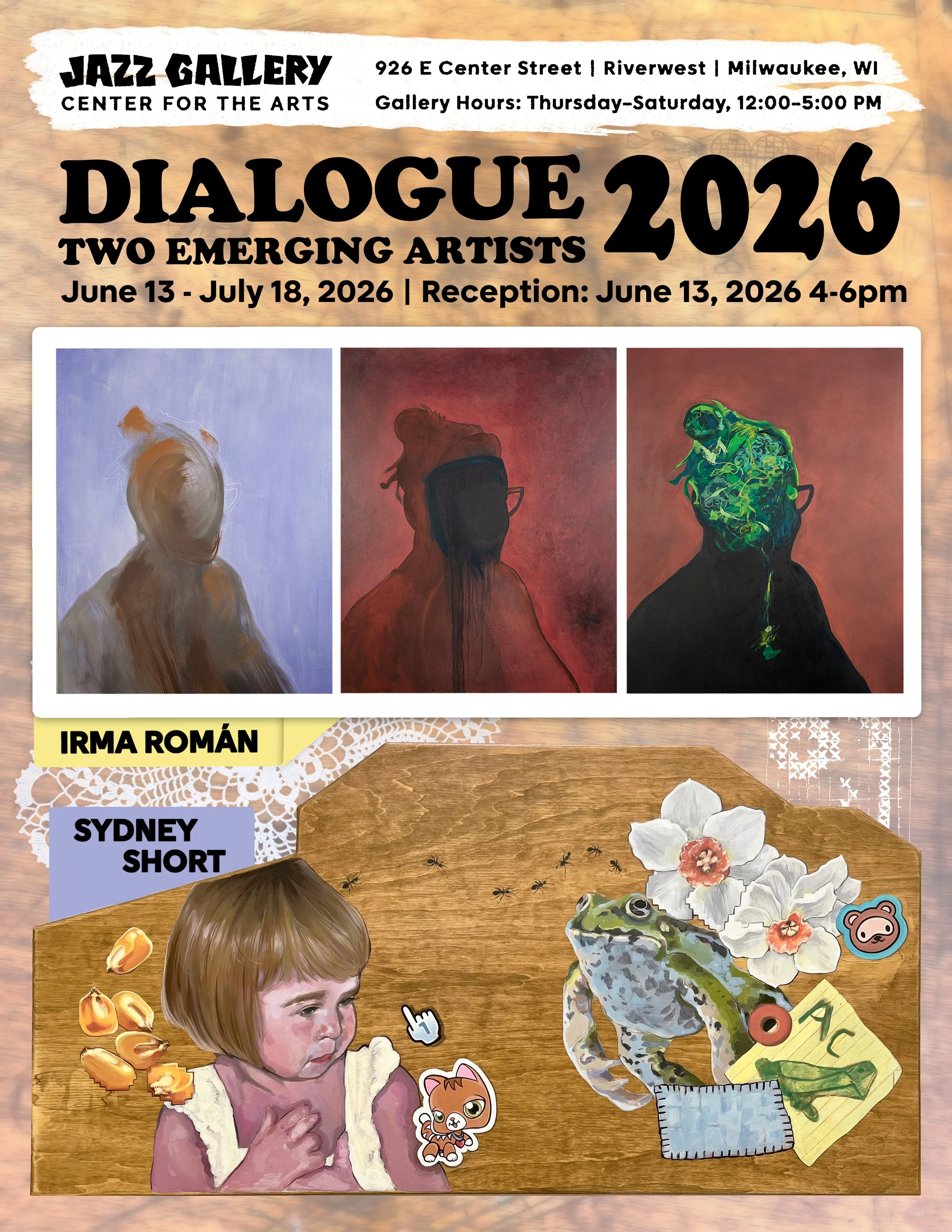
Dialogue 2026
Dialogue is an annual Jazz Gallery Center for the Arts exhibition that honors and lifts up two emerging artists immediately after their BFA exhibitions have closed. Graduating BFA students are chosen from UW-Milwaukee’s Peck School for the Arts and MIAD in an opportunity designed to support and encourage emerging artists and build a stronger community between the two largest university level arts programs in Milwaukee.
About the Artists:
Irma Román (She/Her) is an interdisciplinary artist based in Milwaukee, WI. She received her Associate's degree in Photography from Milwaukee Area Technical College and worked as a portrait photographer for several years before joining the LUNA (Latinas Unidas eN las Artes) artist collective. During her time with LUNA, she returned to exploring several of her other artistic passions, such as painting, drawing and printmaking. Román graduated this May with a Bachelor of Fine Arts in Studio Art, Dual Focus in Painting and Drawing and Photography and Imaging, and a Certificate in Community Arts from the Peck School of the Arts at University of Wisconsin-Milwaukee. Her individual and collective work has previously been exhibited at UWM Union Art Gallery, Kenilworth Square East Gallery, Latino Arts, Walkers Point Center for the Arts, Jazz Gallery Center for the Arts and more. Román’s workoften focuses on visual politics, identity and mental health. Román can be found online at Instagram: @romaloma.art.
About the Work (Irma Román):
The work exhibited in Dialogue, titled The Other Irma, addresses feeling othered; by standard Western culture—through discrimination, marginalization, and/or ostracism. When speaking about the past, Román notes, “I struggled to find a space within the art community where I could feel visible and safe. These moments of “feeling out of place” inspired me to create a series of oil paintings that show how I feel after these experiences have occurred.”
In response to those feelings and experiences Román produced a series of figurative paintings with visual oppositions expressed inside the silhouette of a form, created using a photograph of herself. The portrait size and approach has significant sentimental value: a 3⁄4 angle pose being a traditional standard for portraiture and an homage to her previous career as a portrait photographer. The paintings are presented in a 4 x 5 ratio, her favorite size for photographic sheet film.
Sydney Short (She/Her) is an interdisciplinary artist currently based in Milwaukee, Wisconsin, who just completed her BFA degree at the Milwaukee Institute of Art and Design. Raised in midwestern suburbia just beyond Illinois farmlands, she has a strong connection to the outdoors and her home. That connection greatly influences her work. Through practices passed down from generations of her family, Short uses her “inheritance” to resist the speed and disposability of digital culture. Her work has been exhibited in multiple group shows across Milwaukee, including the Charles Allis Museum, Real Tinsel, and Gray Area.
About the Work (Sydney Short):
For the work exhibited in Dialogue, Short examines the conflicted space between the physical and the digital. She was raised in a suburban home resting just beyond midwestern farmlands, a place where wildlife moved just beyond the yard while the internet slowly moved into the house. Growing up between these forces shaped her understanding of identity as something that is formed through both tactile experience and digital influence.
Utilizing materials and methods that have been passed down through the generations of her family—woodworking, fabrication, painting, sewing, and embroidery—she contrasts this lineage with the inclusion of technological artifacts that signal the digital age encroaching into memory and experience. Through this, Short measures the tension between ancestral knowledge and rapidly evolving technology, highlighting how these domestic-based practices are not just technical processes but also acts of inheritance.